
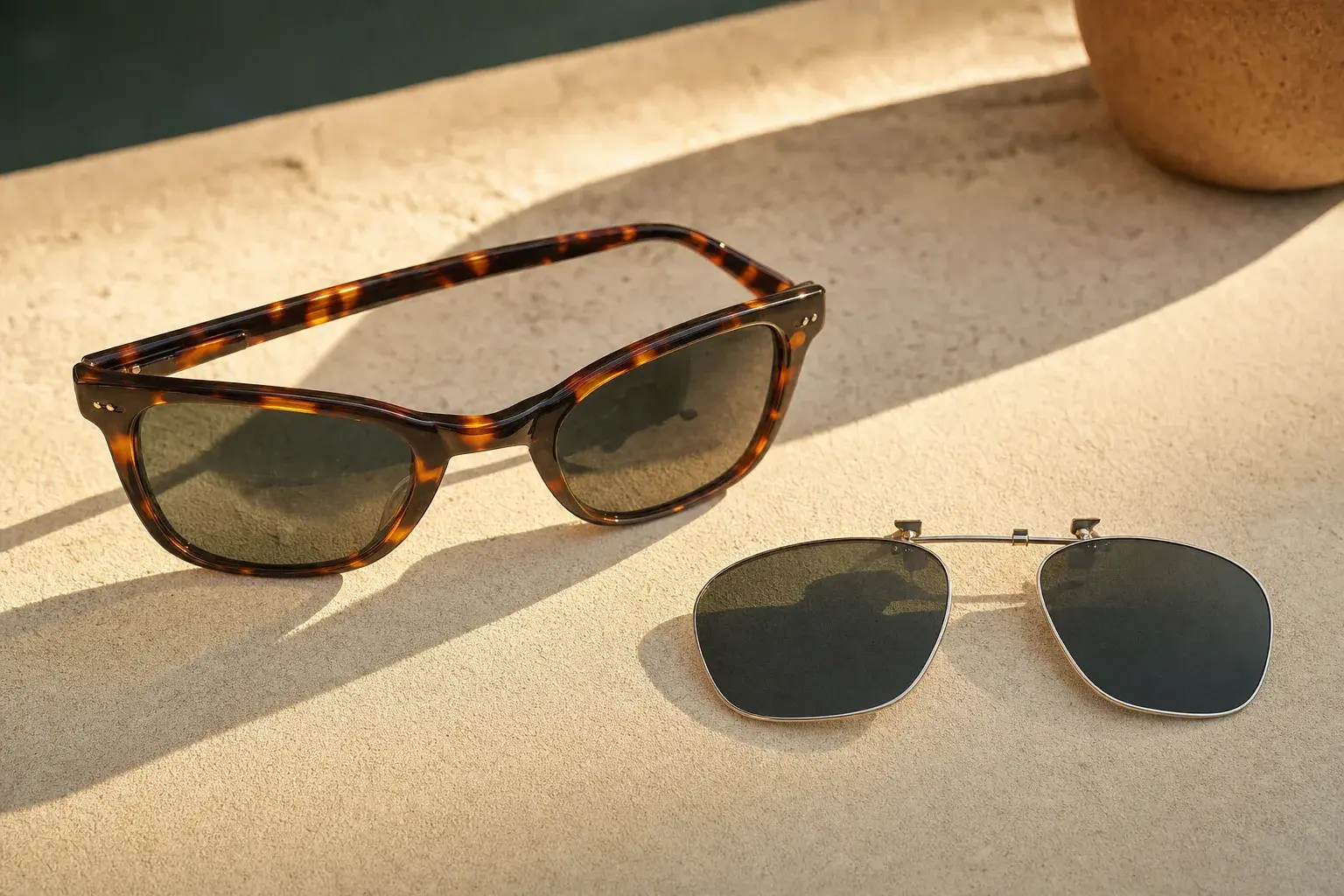
If you need correction to see clearly, the sunglasses problem has no free answer. Sunlight in the Gulf is not a styling consideration — it is the reason you are squinting all the way to the car — and squinting through clear lenses all summer is a headache with extra steps.
There are four routes. None of them is best; they fail in different places.
| Route | Works best when | Where it disappoints |
|---|---|---|
| Dedicated tinted pair | You are outdoors often and want the best optics and looks | It is a second full pair to buy, carry and not lose |
| Photochromic lenses | You move in and out all day and want one pair | They barely darken behind a windscreen, and they are never fully clear indoors |
| Clip-on or magnetic overlay | Budget matters and the sun is occasional | Two layers of lens, more reflections, and it looks like what it is |
| Contacts plus any sunglasses | You already wear contacts comfortably | Contacts do not suit every eye, and dry air makes long days harder |
A dedicated tinted pair
Your prescription, made in a tinted lens, in a frame chosen for sun. It gives the best optical result and the only genuinely sunglasses-shaped sunglasses, and you can specify polarisation and tint independently of the correction — see UV, polarisation and tint for what those three actually do.
Sunglasses generally suit a slightly larger frame than your everyday pair, because light arriving from the side goes straight past a small lens. Size up rather than reusing your optical measurements exactly.
Photochromic lenses
One pair that darkens in ultraviolet light and clears indoors. Genuinely convenient, and the modern versions react quickly. Two caveats worth knowing before you spend: most windscreens block the UV that triggers them, so they stay pale while driving, and they clear more slowly than they darken — walking into a building, you spend a minute or two in lenses that are still tinted.
Clip-ons and magnetic overlays
The cheapest route by a distance, and the least good optically: you are looking through two lens surfaces, which adds reflections and cuts contrast. Magnetic systems designed for a specific frame are much better than universal clips. A reasonable choice if the sun is occasional; a compromise you will feel if it is not.
Contacts with plain sunglasses
If contacts already suit you, this is the most flexible option — any sunglasses in the shop become yours. It is not a free pass: contacts do not suit every eye, air conditioning makes long wear drier, and you still need a pair of glasses for the days you cannot wear them. See glasses or contact lenses for the fuller comparison.
Whatever you choose, check the UV
A tint is comfort; UV blocking is protection, and they are independent. A dark lens with no UV filter lets your pupils open wider and admits more ultraviolet than no sunglasses at all. Every pair we sell blocks UV — if you are buying elsewhere and the pair does not state it, treat it as a fashion accessory rather than as eyewear.
Browse sunglasses, try a shape on your own face first, and ask us if you want a specific frame checked against your prescription before ordering.
Written by
Eyevora Editorial
Fit & styling desk at Eyevora. We stock the frames we write about, and we publish every measurement we hold. Spotted something wrong here? Tell us and we will correct it.
- sunglasses
- prescription
- photochromic
- driving