
A sunglasses lens is doing up to three separate jobs, and the labels tend to blur them into one. Sorting them out takes two minutes and changes what you buy.
| Property | What it does | Does it protect your eyes? |
|---|---|---|
| UV protection (UV400) | Blocks ultraviolet radiation up to 400 nanometres | Yes — this is the protective part |
| Polarisation | Cuts glare reflected off flat surfaces like roads, water and car bonnets | No — it is a comfort and clarity feature |
| Tint / darkness | Reduces overall brightness reaching the eye | No — darkness alone protects nothing |
Why a dark lens without UV is worse than none
Your pupils respond to visible brightness. Put a dark lens in front of them and they open wider, because the eye believes the light has dropped. If that dark lens does not block ultraviolet, the eye is now taking in more UV than it would with no sunglasses at all. This is the single most important fact on this page: darkness is comfort, UV blocking is protection, and they are independent.
Look for UV400, or wording along the lines of 100% UVA and UVB protection. Every pair of sunglasses we sell blocks UV; where a frame's specification lists UV protection, that is what the field means.
When polarisation is worth it
Polarised lenses filter light waves oriented in one plane, which is the form glare takes when sunlight bounces off something flat. On a hot road, off the sea, or across a car's bonnet, the effect is immediate — the white wash disappears and colour and detail come back.
- Worth it for driving, the beach, boating, and anyone who squints through the middle of the day.
- Consider carefully if you read LCD screens outdoors — dashboards, fuel pumps and phone screens can dim or blacken at certain angles.
- Not a substitute for UV protection. A polarised lens without UV blocking is still the wrong lens; most quality lenses do both, but check rather than assume.
Choosing a tint
- Grey — the neutral choice. Dims everything evenly and keeps colours true, which is why it is the default for driving.
- Brown and amber — lift contrast and make edges pop, at the cost of shifting colour slightly. Good in variable light and haze.
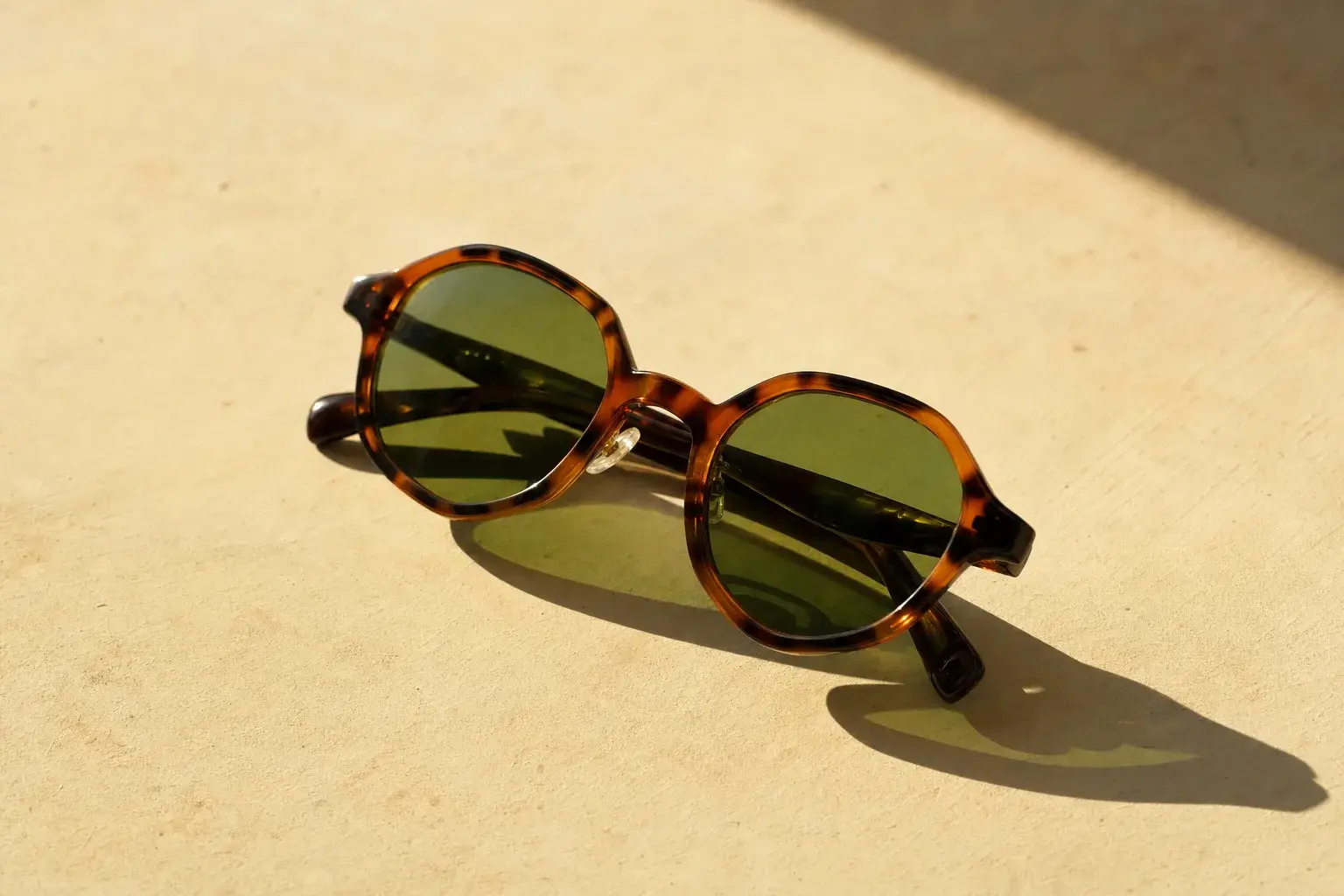
- Green — a middle ground: near-neutral colour with a little extra contrast.
- Mirrored — a reflective coating over any of the above. Cuts a further slice of brightness in very strong light, and shows fingerprints and scratches more readily.
- Gradient — dark at the top, clear at the bottom. Comfortable for driving because the dashboard stays readable while the sky is filtered.
Fit matters more in strong sun
Light arriving from the side and from above goes straight past a small, flat frame. In consistently strong sunlight, a slightly larger lens or a frame with some wrap keeps more of it out — which is why sunglasses tend to suit a size up from the eyeglasses you would choose for the same face.
Kids
Children's eyes are more transparent to UV than adults', and children spend more of the day outdoors. Novelty sunglasses with a dark plastic lens and no UV rating are the exact failure mode described above. If a pair does not state its UV protection, treat it as a toy rather than as eyewear.
Browse sunglasses, and check the total frame width against a pair you already own before deciding — the numbers inside your glasses explains how.
Written by
Eyevora Editorial
Fit & styling desk at Eyevora. We stock the frames we write about, and we publish every measurement we hold. Spotted something wrong here? Tell us and we will correct it.
- sunglasses
- uv protection
- polarised
- lenses