
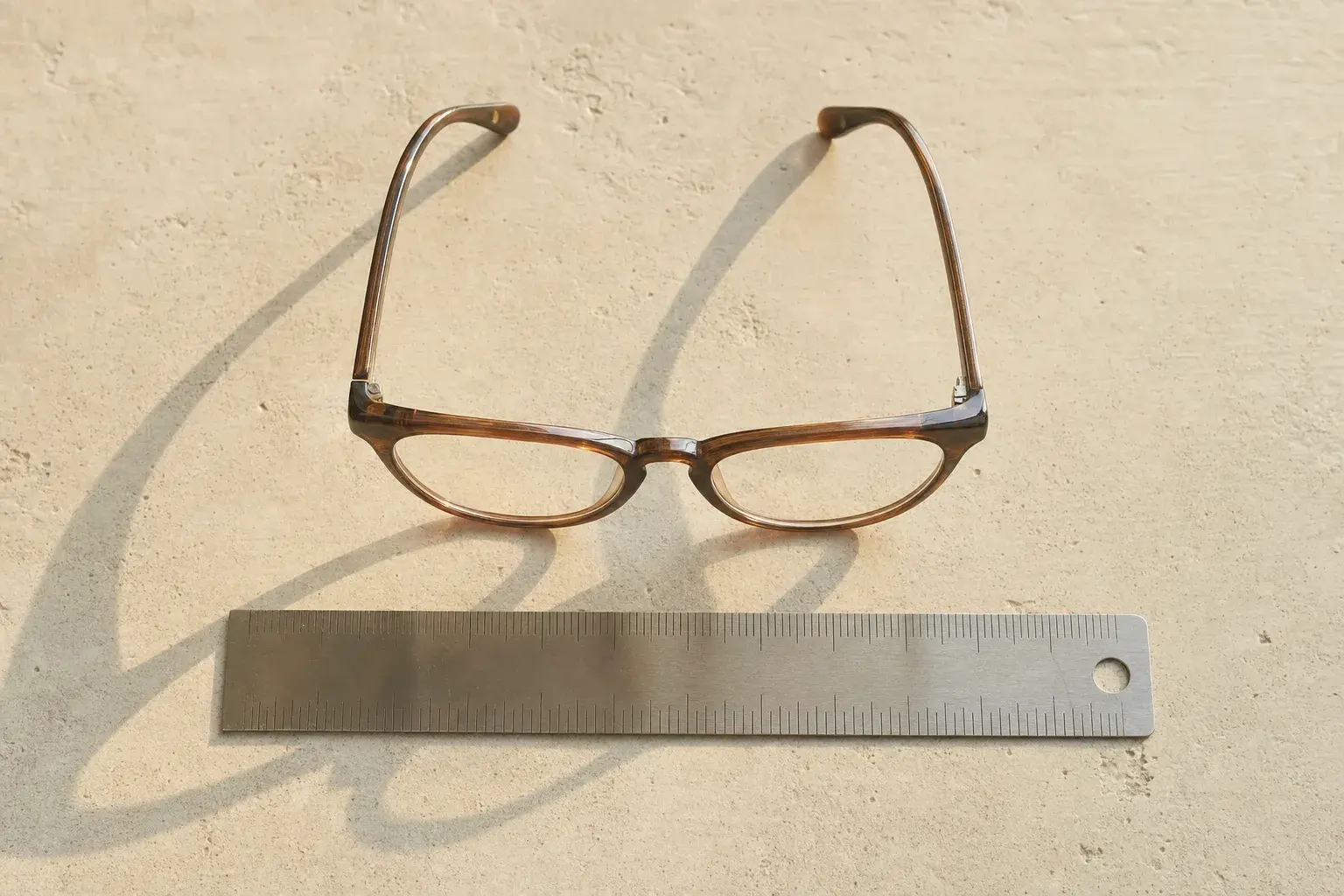
Pick up a pair of glasses you already own and look at the inside of the left temple arm — the part that runs towards your ear. Somewhere along it, usually in very small print, you will find something like 52▫18 145. Those three numbers are the frame's size in millimetres, and they are the closest thing eyewear has to a shoe size.
They are also the reason buying glasses online is far less of a gamble than it looks. You do not need to know your face measurements. You need to know which frame already fits you, and then read its numbers.
What each number means
| Number | Name | What it measures |
|---|---|---|
| First (e.g. 52) | Lens width | The width of one lens at its widest point, in millimetres |
| Second (e.g. 18) | Bridge width | The gap between the two lenses — the part that sits over your nose |
| Third (e.g. 145) | Temple length | The full length of the arm, from the hinge to the tip behind your ear |
Two more measurements matter and are rarely printed on the frame itself, so we list them on every product page: lens height, which decides whether a frame can hold a progressive lens, and total frame width, which is the measurement most responsible for whether a pair looks right on you.
Which one actually decides the fit
Total frame width. If a frame is wider than your face, the arms splay outward and the whole pair slides down your nose all day. If it is narrower, the arms press into your temples and leave marks. Almost every complaint that sounds like a comfort problem is a width problem.
Bridge width comes second, and it is the one people get wrong most often. A bridge too wide lets the frame drop until the lenses sit low; a bridge too narrow leaves the frame perched high with the arms lifting off your ears. If you have a lower nose bridge — common across much of Asia and the Middle East — a smaller bridge number, or a frame with adjustable nose pads, will hold its position far better than a fashionable wide-bridge acetate.
Temple length matters least until it goes wrong. Too short and the arms pull forward at your ears; too long and there is nothing keeping the frame from sliding. 140 to 145mm covers most adults.
Turning that into a purchase
- Find a pair you own that fits comfortably and read the numbers off the temple arm.
- Write them down as three figures: lens width, bridge, temple length.
- Shop within roughly 2mm of the lens width and bridge. That range is the difference between a frame that fits and one that fits slightly differently.
- Treat temple length as a wider band — anything within 5mm is usually adjustable at an optician.
- Check the total frame width on the product page against the frame you measured, not against your face.
No frame to measure?
Measure the width of your face at the temples with a soft tape, from the outside of one temple to the other, and look for a total frame width within about 3mm of it. It is less precise than copying a frame you own, but it will keep you out of the sizes that were never going to work.
Where the numbers stop helping
Millimetres tell you whether a frame will sit correctly. They say nothing about whether you will like it. A 52mm round in clear acetate and a 52mm rectangle in matte black fit identically and look nothing alike, which is exactly why we built the virtual try-on — the numbers settle the fit question so that the mirror question is the only one left.
Full specifications, including lens height and frame width, are listed under Frame Details on every product page. If a measurement you need is missing, tell us and we will add it.
Written by
Eyevora Editorial
Fit & styling desk at Eyevora. We stock the frames we write about, and we publish every measurement we hold. Spotted something wrong here? Tell us and we will correct it.
- sizing
- measurements
- fit