
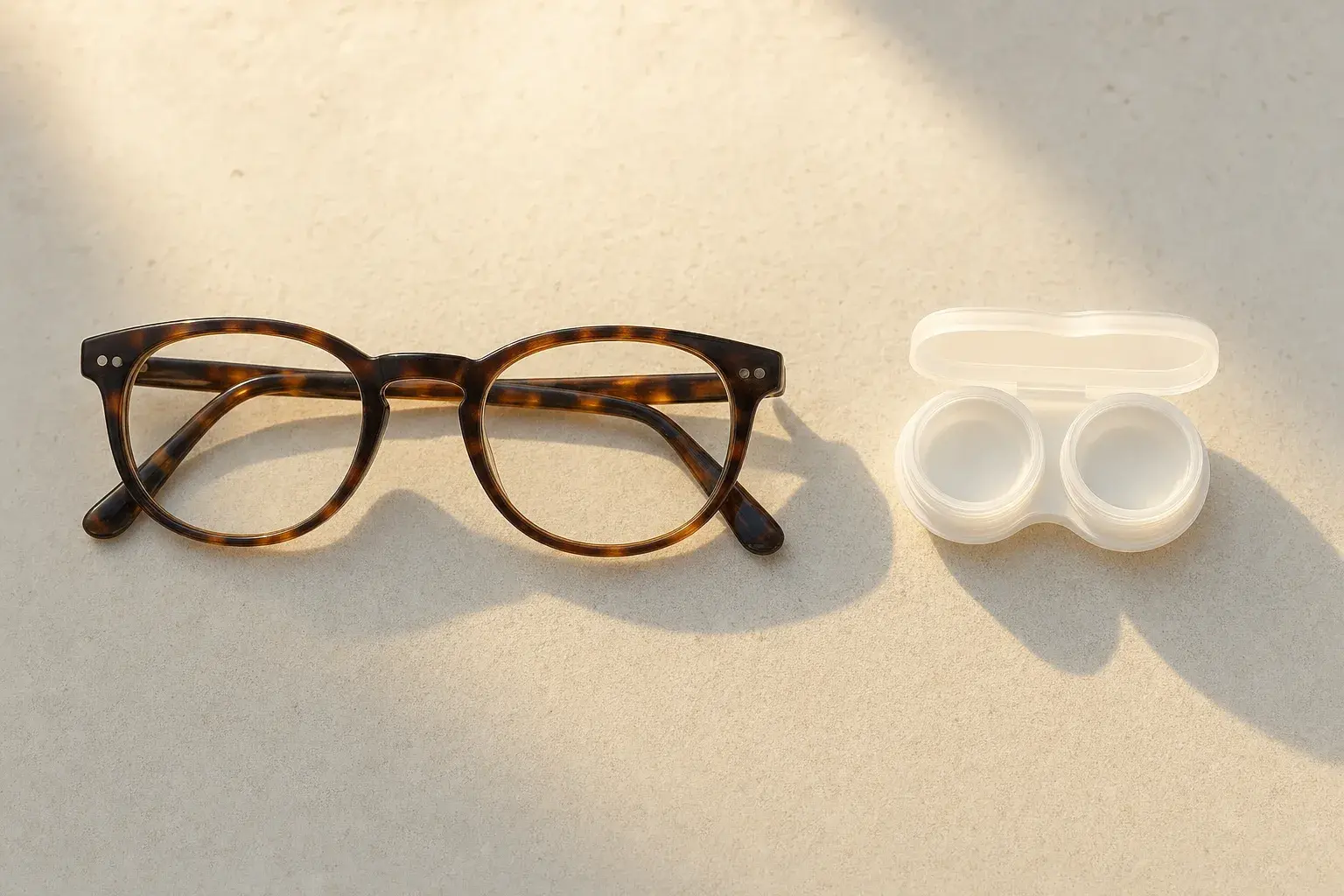
The question is usually framed as a choice, and it rarely is one. Most people who wear contacts also own glasses, because a contact lens is a medical device that sits on the surface of your eye and there are days — a cold, a dusty commute, a very long flight, a late night — when it should not be there.
Contacts need a fitting, not just a prescription
A contact lens prescription is not the same as a glasses prescription. It is measured against a lens sitting on the eye rather than 12mm in front of it, and it adds a base curve and diameter matched to your cornea. Ordering contacts from a spectacle prescription produces the wrong lens on the wrong curve. A practitioner has to fit them, and follow up.
Where glasses win
- Nothing touches your eye. No infection risk, no fitting, no hygiene routine that has to be right every single day.
- They cost less over time. One pair lasts years; contacts are consumed monthly.
- They are a barrier. Dust, air conditioning blowing across a desk, and wind are all easier behind a lens.
- Faster on bad days. Tired eyes, an infection, a stye, a late night — glasses do not care.
- They are visible. Frames are the only medical device that doubles as the most-noticed thing you wear.
Where contacts win
- A full field of view, with no frame edge and no distortion at the periphery — which is why strong prescriptions often feel better in contacts.
- Sport. Nothing to slide, fog or be knocked off.
- Weather. They do not fog walking from a cold room into Gulf humidity, and they do not collect rain.
- Sunglasses. Any pair in the shop works over them.
- They are invisible, which matters to some people and not at all to others.
What contacts actually ask of you
This is the part worth being plain about. Hands washed and dried before every insertion. Never topping up old solution — fresh each time. Never sleeping in lenses unless they were specifically prescribed for it. Never rinsing them in tap water. Replacing them on schedule rather than when they start to feel wrong, because by then they have been wrong for a while.
Most contact lens problems trace back to one of those five, and the consequences run from irritation to a corneal infection that threatens sight. None of it is difficult. It does have to be consistent.
The air-conditioning problem
Conditioned indoor air is dry, and a contact lens sits in your tear film. Long screen days in an office are where most people first notice their lenses drying out — see tired eyes at a desk for what helps. A common and effective pattern here is contacts for the commute and the evening, glasses for the desk hours.
So: both
If your budget allows one thing, make it a pair of glasses that fits properly — it is the option with no daily failure mode. Add contacts for the situations that need them, keep the glasses current rather than letting them fall two prescriptions behind, and stop wearing lenses the moment an eye is red, painful or unusually light-sensitive.
We sell both. Contact lenses are supplied only against a current prescription from a licensed practitioner, and eyeglasses can be tried on your own photograph before you decide.
Written by
Eyevora Editorial
Product & care desk at Eyevora. We stock the frames we write about, and we publish every measurement we hold. Spotted something wrong here? Tell us and we will correct it.
- contact lenses
- glasses
- comparison
- eye care