
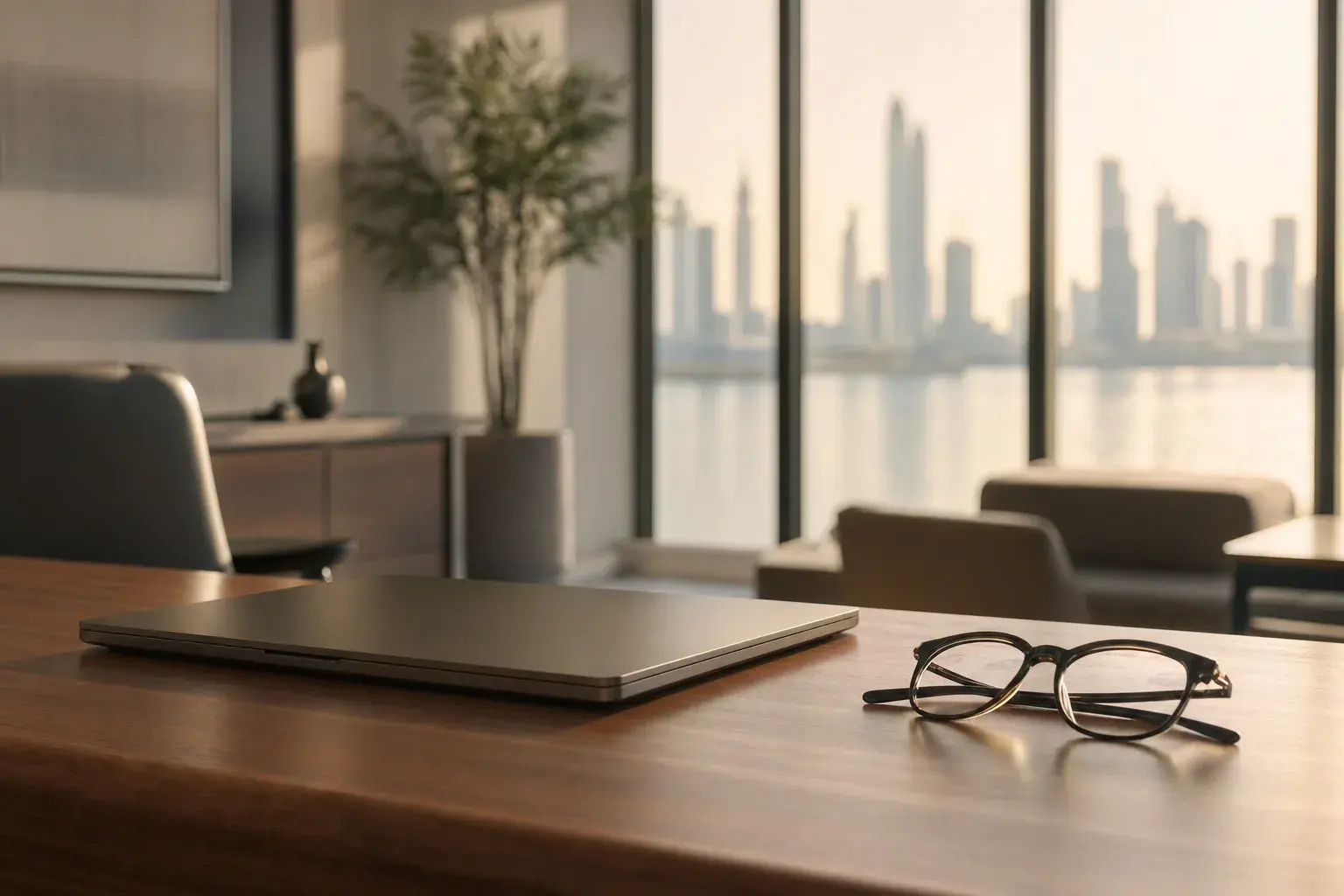
Eight hours at a screen in a heavily air-conditioned office is an unusual thing to ask of a pair of eyes. Two ordinary effects stack up: you blink less when concentrating on a screen, and conditioned air is dry. The result is the familiar end-of-day combination — gritty, tired eyes and a headache sitting behind them.
When to see an optometrist rather than read an article
Persistent eye pain, a sudden change in vision, double vision, flashes, floaters, or headaches that do not settle are reasons to book an eye examination promptly. Tired eyes at the end of a long day are ordinary; those symptoms are not, and no lens coating is the right response to them.
The things that reliably help
Look away, on a schedule
The widely taught habit is the 20-20-20 rule: every 20 minutes, look at something about 20 feet (6 metres) away for 20 seconds. The exact numbers are a mnemonic rather than a clinical threshold. What matters is that your focusing muscles spend part of the day doing something other than holding one fixed distance, and that you blink properly while you are at it.
Fix the geometry before the lenses
- Screen slightly below eye level. Looking down a little means your eyelids cover more of the eye surface, which slows evaporation.
- About an arm's length away. Closer than that, and the eyes converge harder for longer.
- Match the screen to the room. A bright screen in a dim room, or a dim screen against a window, makes the eye work at the contrast rather than at the content.
- Get the air off your face. A vent blowing directly at a desk dries eyes faster than the screen ever will. Move the desk or redirect the vent.
Deal with the dryness
In a dry, conditioned room, deliberate blinking and lubricating drops do more for comfort than anything you can buy for your glasses. If you wear contact lenses through long screen days, dryness usually shows up sooner — a pair of glasses for desk hours is a genuinely effective change.
Rule out the prescription
An uncorrected or slightly outdated prescription turns every screen hour into low-grade effort, and it feels exactly like screen fatigue. Small amounts of uncorrected astigmatism are a classic cause of end-of-day headaches in people who are certain their vision is fine. If it has been a while, book a test before buying anything.
The honest note on blue-light lenses
Blue-light filtering lenses are sold hard, and the strong version of the claim — that they prevent digital eye strain — is not something we are willing to state as fact. The evidence for that specific benefit is contested. What is not contested is that light exposure in the evening affects sleep timing, and that many people find reduced glare more comfortable.
So: if you like how they feel, they are a reasonable thing to buy. If your eyes hurt at 5pm, buy them *after* you have fixed the vent, the screen height, the blinking, and the prescription — because those are the parts most likely to be causing it.
Most desk eye strain is a room problem and a habit problem before it is a lens problem.
If you are setting up a dedicated pair for desk hours, talk to us about lens options — and see how to read your prescription before you order.
Written by
Eyevora Editorial
Product & care desk at Eyevora. We stock the frames we write about, and we publish every measurement we hold. Spotted something wrong here? Tell us and we will correct it.
- screen time
- eye strain
- blue light