
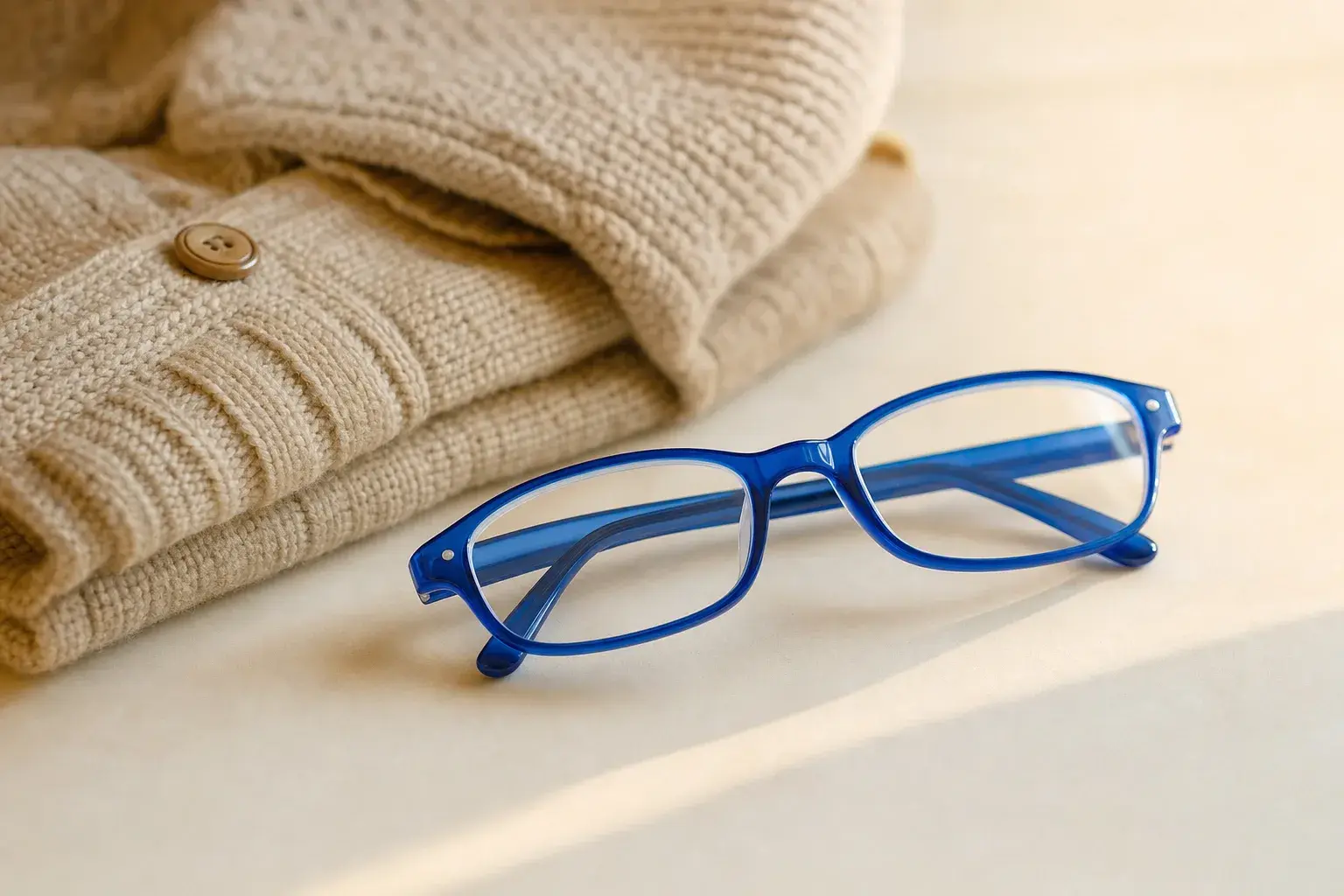
A child's glasses have one job: to be worn. Everything else — the material, the shape, the price — matters only insofar as it serves that. A perfect prescription in a frame that slides down a nose all morning gets pushed up onto a forehead by lunchtime and does nothing at all.
The eye test comes first, and it repeats
Children's eyes change fast, and a child rarely reports blurred vision — they have no baseline to compare against, so they assume everyone sees what they see. Sight tests on the schedule your optometrist sets, not when a problem becomes obvious. Some conditions are treatable in childhood in ways they are not later.
The bridge decides everything
A child's nose bridge is still developing and is much flatter than an adult's. This is the single most common reason children's glasses slide, and it is why an adult frame scaled down does not work: it is built for a bridge that is not there yet.
- Look for frames designed for children, with a low, wide bridge that sits on the nose rather than pinching a ridge.
- Adjustable nose pads on a metal frame let an optician tune the fit as the face changes.
- The frame should sit without leaving a red mark, and stay put when the child looks down at a book — the test to run in the shop, or at home when the box arrives.
Temples: straight, curled or a strap
Curl-sided temples wrap behind the ear and are the standard answer for toddlers and any child who is active in them. For babies and the very young, a soft strap around the back of the head is better than any arm. Straight temples are fine for older children who have been wearing glasses for a while.
Material, and what happens when it is sat on
TR90 and similar nylons bend a long way and return to shape, which is exactly what a frame needs to survive a school bag. They are light and they resist heat and sweat. The trade-off is that they spring back rather than being adjustable, so the size has to be right from the start — see frame materials compared.
Spring hinges are worth insisting on. They let the temples flex outward past their normal travel instead of snapping, and most children's frame breakages are hinge breakages.
Lenses
- Polycarbonate, essentially always. It is the impact-resistant material, it is lighter than standard plastic, and it carries UV protection inherently.
- Anti-reflective and hard coatings help, but expect scratches anyway; treat them as consumables on a young child's pair.
- UV protection outdoors is not optional. Children's eyes transmit more UV than adults', and children spend more of the day outside. If the sunglasses do not state their UV rating, they are a toy — the reasoning is in UV, polarisation and tint.
Let them choose
Within the frames that fit, the choice should be the child's. Compliance is the entire game, and a child who picked their own glasses wears them. Ordering online helps here rather than hurting: shortlist two or three frames that fit the bridge and the width, then let them pick the colour, and try the shortlist on a photo before it arrives.
Check the fit every few months, and have the prescription re-checked on your optometrist's schedule. If something breaks in a way it should not have, our returns and warranty terms are written to be read — and we will tell you plainly whether a frame is a sensible match for a particular child before you order.
Written by
Eyevora Editorial
Product & care desk at Eyevora. We stock the frames we write about, and we publish every measurement we hold. Spotted something wrong here? Tell us and we will correct it.
- kids
- sizing
- durability
- eye tests