
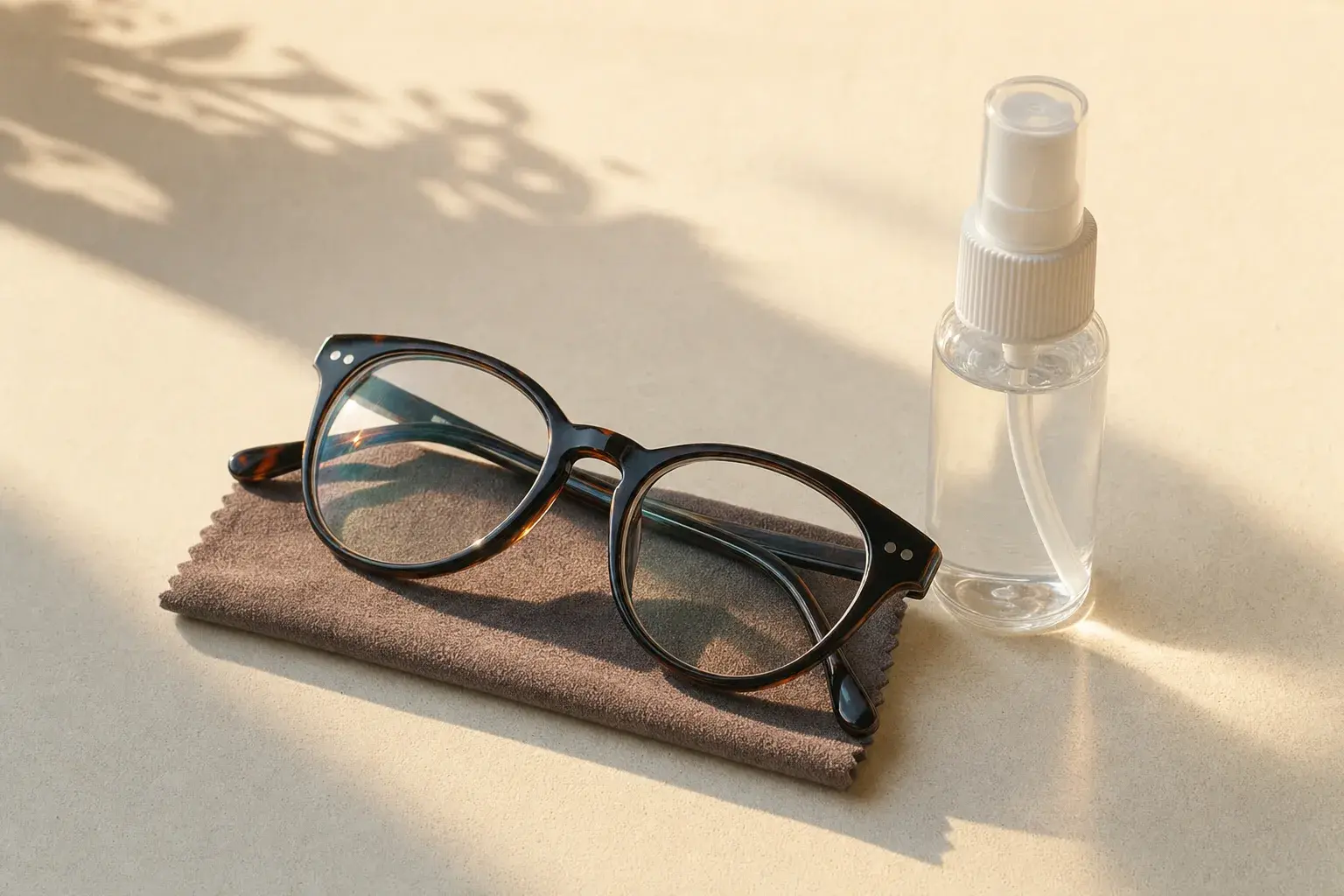
Modern lenses are not bare glass or plastic. They carry stacked coatings — anti-reflective, hard coat, sometimes a hydrophobic top layer — that are only micrometres thick. Almost every cleaning mistake is really a coating mistake, and coatings do not grow back.
The method
- Rinse first, under lukewarm running water. This is the step people skip and the reason most lenses get scratched: dry-wiping drags grit across the surface. Rinsing floats it off.
- Add a drop of plain washing-up liquid to your fingertips and work it gently over both sides of each lens, the nose pads and the hinges.
- Rinse thoroughly, until the water sheets off cleanly rather than beading in patches.
- Shake off the water and dry with a clean microfibre cloth, without pressure. If the cloth is not clean, you are polishing with whatever it picked up last time.
- Wash the microfibre cloths themselves every couple of weeks — no fabric softener, which leaves a film that smears.
Hot water is not a shortcut
Hot water can craze coatings and loosen the adhesive holding lenses in some frames. Lukewarm only. The same applies to leaving glasses on a car dashboard in the sun — the temperature inside a parked car in a Gulf summer will warp acetate and lift coatings on its own.
What not to use
- Your shirt, a tissue, kitchen roll or a napkin. Wood-pulp paper is abrasive at the scale a coating cares about, and a shirt-tail is a dust collector.
- Glass cleaner and household sprays. Ammonia and similar solvents are formulated for uncoated window glass and attack anti-reflective stacks.
- Alcohol wipes and hand sanitiser. Repeated alcohol contact dulls coatings and, on acetate frames, can leave them chalky.
- Vinegar, bicarbonate of soda and other internet remedies. Acidic and abrasive respectively; both do exactly what you would expect to a thin optical film.
- Breath and a rub. Fine for a smudge in an emergency, terrible as a daily habit — there is nothing floating the grit away.
Keeping the frame straight
Lenses get the attention; the frame is what actually determines whether the glasses sit right. Two habits cover most of it.
- Take them off with two hands. One-handed removal twists the frame a little every time, and the accumulated result is a pair that sits crooked and a wearer convinced their ears are uneven.
- Store them lenses-up in a hard case, not face-down on a desk. Face-down on any surface is how the centre of a lens gets scratched, which is the one place you cannot ignore it.
Sunglasses need the same routine, more often. Sunscreen, salt water and sweat are all harder on coatings than dust is, and all three arrive together on a beach day. Rinse them the same evening rather than the following week.
When to stop cleaning and get them looked at
If lenses look permanently hazy after a proper wash, the coating has degraded and no cleaning will bring it back — that is a lens replacement. If the frame no longer sits level, most opticians will adjust it in a few minutes, often at no charge. If something has failed rather than worn out, check our returns and warranty terms or get in touch.
Written by
Eyevora Editorial
Product & care desk at Eyevora. We stock the frames we write about, and we publish every measurement we hold. Spotted something wrong here? Tell us and we will correct it.
- care
- cleaning
- lens coatings