
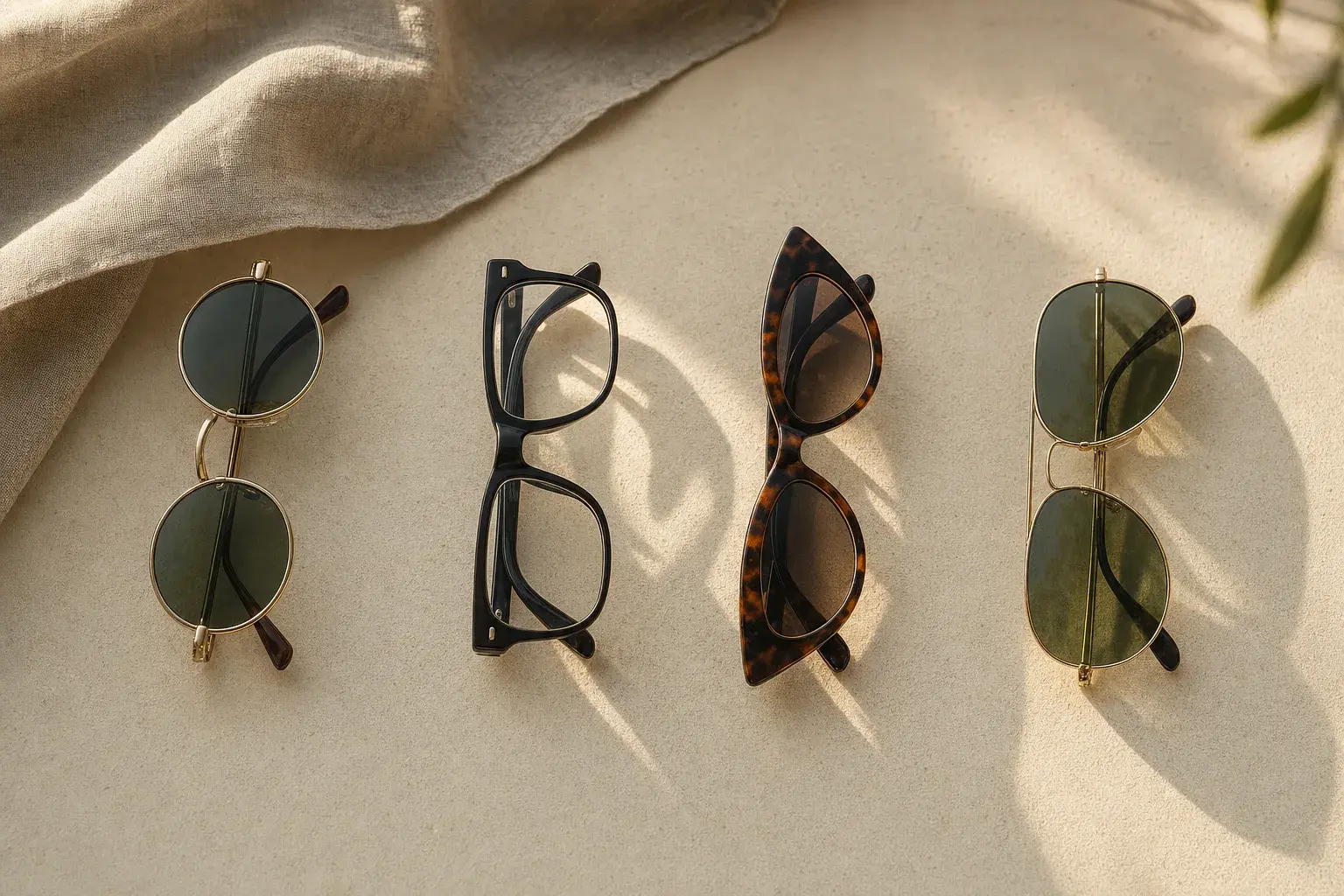
Search for how to choose glasses and you will find the same chart everywhere: round face, wear angular frames; square face, wear round frames; heart-shaped face, wear something wider at the bottom. The chart is not wrong, exactly. It is one idea — contrast — dressed up as a system with seven rules.
The idea is that a frame shape which differs from your face's dominant lines draws attention to the difference, and difference reads as definition. That is all. Once you know that is what the chart is doing, you can use it properly, which mostly means using it loosely.
The starting points
- Rounder faces — softer jaw, similar width and length. Angular frames (rectangle, square, geometric) add lines the face does not already have.
- Squarer faces — a defined jaw and a broad forehead. Round and oval frames soften the corners; very angular frames can double down on them.
- Oval faces — balanced proportions. Genuinely the easiest case: most shapes work, so choose on colour and size instead.
- Heart-shaped faces — wider at the forehead, narrower at the chin. Frames that are lighter on top (rimless, half-rim, thin metal) avoid stacking width where there is already plenty.
- Longer faces — noticeably taller than wide. Deeper frames with a strong brow line break up the vertical run; very narrow frames exaggerate it.
Three things that matter more
1. Width, again
A frame in the theoretically correct shape but the wrong width will look worse than the theoretically wrong shape in the right one. The outer edges of a frame should land at roughly the widest part of your face. That single alignment does more visible work than any shape rule — see the numbers printed inside your glasses for how to check it.
2. Where the top bar sits
The upper edge of a frame reads as an eyebrow line. When it sits just below or along your brows, the face looks composed. When it cuts across the middle of the brows, or floats well above them, something looks off in a way most people cannot name. Check this in every try-on photo — it is easy to see and easy to fix by changing the frame, not the frame's shape.
3. Contrast between frame and colouring
Heavy, dark acetate on a high-contrast face is a statement; the same frame on softer colouring can take over entirely. If you want glasses that read as part of your face rather than as an accessory, go lighter — thin metal, translucent acetate, half-rim. If you want them noticed, do the opposite deliberately.
The chart tells you where to start looking. Your own face on a screen tells you whether it worked.
How to actually decide
- Use the shape guidance to narrow a hundred frames to ten. That is all it is for.
- Filter those ten by size, using measurements from a frame you already own.
- Try the survivors on a photo of your own face and look at three things: total width, where the top bar meets your brows, and whether the frame reads as you.
- Sleep on the shortlist. Frames that only look good in the first ten seconds tend to stop looking good in week three.
A note on trends
Frame trends move slowly and then all at once — very small ovals, very large squares, wire everything. A trend frame is a fine second pair and an expensive only pair. If you are buying one pair to wear every day for two years, choose the shape you keep coming back to rather than the one that is currently everywhere.
Ready to narrow things down? Browse eyeglasses or sunglasses and try the shortlist on before you decide.
Written by
Eyevora Editorial
Fit & styling desk at Eyevora. We stock the frames we write about, and we publish every measurement we hold. Spotted something wrong here? Tell us and we will correct it.
- style
- face shape
- choosing frames